
Charlotte, NC
Clinical trials in Charlotte, and whether you qualify.
Two ways to start: check your eligibility for every study in the Charlotte area in one go, or browse the 90 conditions we screen for. Both are free.
Every condition we can match you to
Nine groups, 86 conditions. Tap one to open it. Everyday words work here.
Everyday words work. Try “sugar”, “snoring”, “bald spots”.
We do not have a study for that one right now.
Tell us what you have and we will keep looking for you around Charlotte.
See what I qualify for →
Weight, blood sugar & hormones
10 conditions
Weight, blood sugar & hormones
10 conditions
Weight, blood sugar and the thyroid all get checked by the same studies, so one form covers the lot.
Weight loss
Trouble losing weight, or told you are obese
Type 2 diabetes
High blood sugar, high A1C, on metformin
Type 1 diabetes
Diagnosed young, on insulin
Borderline blood sugar
Prediabetes, or told you have metabolic syndrome
Losing muscle on a weight loss shot
Muscle wasting while on a GLP-1, sarcopenia
A wound on the foot that will not heal
Diabetic foot ulcer
PCOS
Irregular periods, cysts on the ovaries
Underactive thyroid
Tired, cold, gaining weight, hypothyroidism
Overactive thyroid
Racing heart, weight loss, jitteriness, Graves’
Bulging or painful eyes
Eye changes caused by a thyroid problem
Heart, blood pressure & circulation
10 conditions
Heart, blood pressure & circulation
10 conditions
Heart, blood pressure and cholesterol studies almost always run the same tests, so one form reaches all of them.
High blood pressure
Also called hypertension
High cholesterol
High LDL, triglycerides, on a statin
Heart failure
Breathless, swollen ankles, a weak pumping heart
Blocked arteries
Chest pain, a stent, a bypass, coronary artery disease
Stroke
A stroke, or a mini stroke called a TIA
Irregular heartbeat
Atrial fibrillation, a fluttering or racing heart
Cramping legs when you walk
Peripheral artery disease
Blood clots
A clot in the leg or lung, DVT or PE
A leaky or narrowed heart valve
Aortic stenosis, valve disease
High pressure in the lungs
Pulmonary hypertension
Kidneys, liver & blood
9 conditions
Kidneys, liver & blood
9 conditions
Bloodwork is what decides these studies, so the more of your recent numbers you can tell us, the better the match.
Fatty liver disease
Fat in the liver, NASH or MASH
Kidney disease
Failing kidneys, on dialysis, low eGFR
Protein or blood in the urine
IgA nephropathy, FSGS, membranous, polycystic kidneys
Low iron or low blood count
Anemia, iron deficiency
Sickle cell disease
Pain crises, inherited from birth
A bleeding disorder
Hemophilia, bruising and bleeding easily
Hepatitis B or C
A liver infection that will not clear
Primary biliary cholangitis
Itching and fatigue from a bile duct condition
High potassium
Hyperkalemia, or another electrolyte problem
Breathing & sleep
11 conditions
Breathing & sleep
11 conditions
Sleep and breathing studies run at several Charlotte clinics. Tell us everything about your breathing and your nights.
Sleep apnea
Loud snoring, waking up tired, a CPAP machine
Asthma
Wheezing, an inhaler, attacks
COPD
Emphysema, chronic bronchitis, breathless from smoking
Cannot sleep
Insomnia that has lasted months
Restless legs or sudden sleep attacks
Restless legs, narcolepsy
Sleepy all day, every day
Idiopathic hypersomnia
Blocked nose that will not clear
Nasal polyps, chronic sinus trouble
A cough that will not go
Chronic cough lasting more than eight weeks
Scarred lungs
Pulmonary fibrosis, IPF, interstitial lung disease
Bronchiectasis
Repeated chest infections, coughing up phlegm
Cystic fibrosis
Diagnosed in childhood, thick mucus
Joints, autoimmune & psoriasis
11 conditions
Joints, autoimmune & psoriasis
11 conditions
These overlap more than most people expect, and the same study often accepts two or three of them. List everything you have been told you have.
Psoriasis
Thick, scaly, flaking patches on skin or scalp
Lupus
Fatigue, joint pain, rashes that flare and fade
Rheumatoid arthritis
Swollen, stiff joints on both sides of the body
Painful lumps under the skin
Boils in the armpits or groin, hidradenitis suppurativa
Psoriatic arthritis
Joint pain along with psoriasis
Back and spine pain
Stiffness worse in the morning, ankylosing spondylitis
Dry eyes and dry mouth
Persistent dryness, Sjögren’s
Kidney trouble from lupus
Lupus nephritis, protein in the urine
Muscle weakness that gets worse through the day
Myasthenia gravis, droopy eyelids, double vision
Tight, hardening skin
Scleroderma, systemic sclerosis
Inflamed blood vessels
Vasculitis, polymyalgia rheumatica, giant cell arteritis
Stomach & gut
7 conditions
Stomach & gut
7 conditions
If your day gets planned around the nearest bathroom, this is the group. One form covers all seven.
Ulcerative colitis
Urgent, bloody diarrhea and cramping
Crohn’s disease
Belly pain, diarrhea, weight loss
IBS
Cramping, bloating, unpredictable bathroom trips
Celiac disease
Gluten makes you sick
Food gets stuck when you swallow
Trouble swallowing, EoE
Heartburn or a slow stomach
Reflux, GERD, gastroparesis
Constipation that will not shift
Chronic constipation
Skin, hair & appearance
9 conditions
Skin, hair & appearance
9 conditions
Itch studies and appearance studies often run at the same site, and many take more than one of these at once.
Eczema
Itchy, dry, inflamed skin, atopic dermatitis
Chronic hives
Welts that keep coming back for months
Itching that will not stop
Chronic pruritus, prurigo, itchy hard bumps
Hair loss in patches
Bald spots on the scalp, beard or brows, alopecia areata
White patches of skin
Skin losing its color, vitiligo
Acne
Persistent breakouts that treatments have not fixed
Rosacea
Facial redness, flushing, visible vessels
Rough spots from sun damage
Actinic keratosis, skin lesions
Lines and wrinkles
Cosmetic and aesthetic studies
Pain, nerves & bones
11 conditions
Pain, nerves & bones
11 conditions
Pain gets labeled a dozen different ways and the labels overlap. Tell us where it hurts and how long it has hurt.
Gout
Sudden severe pain, often in the big toe
Worn out joints
Osteoarthritis in the knee, hip or hands
Migraine
Headaches with light sensitivity or nausea
Pain that has lasted months
Chronic pain anywhere in the body
Chronic low back pain
Back pain that has lasted more than three months
Numbness or tingling in the feet
Peripheral neuropathy
Burning nerve pain
Neuropathic pain, often from diabetes
Widespread aching and fatigue
Fibromyalgia
Thin or broken bones
Osteoporosis, a fracture from a small fall
A painful shoulder, elbow or tendon
Tendinopathy, a sports injury
Pain after an operation
Pain after surgery, or sudden pain
Mental health & brain
12 conditions
Mental health & brain
12 conditions
What has already been tried and not worked is usually what decides which study fits. List every medicine, including the ones that failed.
Depression
Feeling flat, empty, or unable to enjoy things you used to
Anxiety
Constant worry you cannot switch off
Schizophrenia
Hearing or seeing things others do not
Bipolar disorder
Swings between very high and very low periods
PTSD
Flashbacks or nightmares after something traumatic
ADHD
Trouble focusing, restlessness, disorganization
Drinking more than you want to
Alcohol use disorder
Trouble with opioids or other substances
Opioid or substance use disorder
Alzheimer’s and memory loss
Forgetting recent things, repeating questions
Parkinson’s
Tremor, stiffness, slow or shuffling movement
Lewy body dementia
Memory changes with movement problems or visions
Uncontrolled movements
Twitching from a psychiatric medicine, tardive dyskinesia
Why people take part
You can make a difference
People join for two reasons. Their own health, and everyone who needs the treatment later. You can join for either one.
Someone is watching your health closely
A study team sees you on a set schedule. They check your blood, your weight, your blood pressure. Catching things early is their job.
Medicine the pharmacy does not have yet
Some studies test medicine years before it reaches a pharmacy. The visits, the lab work and the medicine cost you nothing.
Paid for your time
Most Charlotte visits pay 25 to 250 dollars. You see the number in writing first.
The next person
Every medicine in your cabinet exists because someone volunteered first. You would be doing that for the next person.
It matters more here than most places
North Carolina sits in the bottom half of the country for diabetes. About 13 in 100 adults have it. More than a third of adults are living with obesity. Those are the conditions Charlotte clinics need people for most. The studies will not finish without people from here.
Before you start
What it means to take part in a study
Clinical trials test new medicine before a doctor can prescribe it. Volunteers make that possible.
It costs you nothing
No insurance needed. The visits, the tests and the medicine are all paid for by the study.
You get paid for your time
Most Charlotte visits pay 25 to 250 dollars. You see the number in writing before you agree to anything.

Someone checks it first
The Food and Drug Administration regulates trials. An independent board approves every study before anyone joins.
Before you say yes
You might get a placebo.
Ask the clinic your odds.
Not every study fits.
New ones open most months. One form covers them all.
You can stop any time.
Any reason, no penalty.
It does not replace your doctor.
Keep seeing them. In an emergency call 911.
Not sure which study is right for you?
Answer a few questionsCompensation
Paid clinical trials near Charlotte, NC
How the money works. Most people are never told, so they assume the worst.

01
The first conversation is free
A phone call or a short visit where the clinic explains the study and answers your questions. Nobody is paid for that. You can stop right there.
02
The first real visit is paid
This one is longer. Paperwork, blood work, blood pressure. You are paid for showing up to it.
03
It pays for your time, not the treatment
Hours off work, gas, parking, childcare, the drive. It is never a fee for taking medicine.
04
An independent board sets the amount
The same medical board that approves the study approves the payment. The clinic cannot raise it.
05
It arrives after each visit
Usually a prepaid card or a check, a few weeks after each visit.
Everything here is within an hour of you
Twelve independent research clinics across the Charlotte area. Tether runs none of them.
90
conditions we cover
12
independent research clinics
~2 hrs
to hear back from us
14
towns inside an hour
Research in Charlotte
Why Charlotte is a good place to look
A teaching hospital, two health systems and a dozen independent clinics, all inside an hour.
A teaching hospital city now
Wake Forest University School of Medicine opened Charlotte’s first four year medical school in 2025, alongside Atrium Health. Studies follow teaching hospitals, and Charlotte now has one.
Two health systems, not one
Atrium Health and Novant Health both run their own research programs here. Novant has been at it since 1987. When two systems compete for the same patients, both keep a research department.
Your own doctor might be running one
Charlotte Gastroenterology, Tryon Medical Partners, the dermatology group and the allergy practice all run studies inside their normal offices. The study can happen where you already go.
Memory research has a home here
Flourish Research in Matthews used to be the Alzheimer’s Memory Center. If the problem is memory, this is a real strength of the area rather than an afterthought.
An hour covers the whole thing
Mecklenburg, Union, Cabarrus and Gaston counties all sit inside about an hour of uptown. So do Rock Hill and Fort Mill across the South Carolina line. Weekly visits are doable when the drive is short.

Where the studies happen
The clinics running Charlotte’s studies
These are the hospitals and clinics that run the studies. Tether is not one of them and runs none of its own.

Atrium Health
Multiple Charlotte locations · 161+ active studies
Crohn’s, heart failure, COPD, dementia, type 2 diabetes, blood pressure
Charlotte’s biggest health system, tied to Wake Forest University School of Medicine. It runs far more studies than anyone else nearby.
Visit website →
American Health Research Network
Ballantyne · 25 to 30+ active studies
Asthma, COPD, chronic cough, type 2 diabetes
Led by Dr Selwyn Spangenthal. The biggest private lung research group in Charlotte, with offices in Charlotte, Rock Hill, Lake Norman and Charleston.
Visit website →
Monroe Biomedical Research
Monroe · 17+ active studies
Asthma, COPD, blood pressure, weight, colitis
One of the five busiest research sites in the country. Its 6,300 square foot space can host overnight stays.
Visit website →
Clinical Research of Gastonia
Gastonia · 11+ active studies
Asthma, COPD, chronic cough, sleepiness
Led by Dr Anup Banerjee. Sits next to CaroMont Regional Medical Center and has been running for over ten years.
Visit website →
OnSite Clinical Solutions
Ballantyne · 10+ active studies
Colitis, Crohn’s, COPD, heart failure, eczema
Works with Charlotte doctors in heart, gut, skin, nerve and joint care. Runs studies from first in human through to late stage.
Visit website →
Flourish Research
Matthews · 4+ active studies
Alzheimer’s, early Alzheimer’s, memory
Led by Dr M. Reza Bolouri, who has more than twenty years in Alzheimer’s research. An Alzheimer’s Center of Excellence.
Visit website →Show the other six clinics

New Hope Clinical Research
SouthPark · 4+ active studies
Mental health, memory, gut
Led by Dr Kurian Abraham. Thirty beds for overnight stays, a clean last FDA audit, and more than 200 brain studies finished.
Visit website →
Queen City Clinical Research
SouthPark · 2+ active studies
Pain
Led by Dr Leonardo Kapural, a former Cleveland Clinic professor with more than 200 journal articles. Many call this the biggest pain research site in the country.
Visit website →
Novant Health
Multiple Charlotte locations · Several active studies
Heart disease, weight, blood pressure
One of the biggest health systems in the Carolinas. Its Heart and Vascular Institute runs heart studies and sees a lot of patients.
Visit website →
Dermatology, Laser and Vein Specialists
Four Charlotte area offices · 1+ active studies
Eczema, psoriasis, rosacea
Led by Dr Gilly Munavalli. An award winning skin practice with more than fifty FDA approved lasers and devices, and its own research team.
Visit website →
DelRicht Research
South Charlotte · 1+ active studies
Bipolar disorder, bipolar depression
Part of a national network of mental health research sites. Currently running a bipolar depression study in Charlotte.
Visit website →
TMS of the Carolinas
South Charlotte · 1+ active studies
Depression that has not responded to treatment
A specialty site for brain stimulation care. It runs the fast TMS study that packs six weeks into two.
Visit website →What each clinic is running changes month to month. Fill in one form and we tell you which one to call.
Common questions
Questions people ask before they start
If yours is not here, ask us. We answer in writing.
Do you get paid for clinical trials in Charlotte NC?
Yes, in almost every case. The payment is for your time and travel, not for the treatment. Most visits pay somewhere between 25 and 250 dollars depending on the study. The exact number is written down for you before you agree to anything.
Does it cost anything to take part?
No. The visits, the tests and the medicine are all paid for by the company running the study. Tether is free and never charges you a thing.
Do I need health insurance?
No. A study does not bill your insurance for anything to do with the study, and you can take part with no coverage at all.
Will I get a placebo?
You might. Many studies compare a new treatment against an inactive one so the results mean something. Not every study uses a placebo. In some, everybody gets the real treatment eventually. Ask the clinic what your odds are before you start. They have to tell you.
Can I leave a study after I start?
Yes. At any time, for any reason. You do not owe anyone an explanation and there is no penalty.
What if there is nothing for my condition right now?
It happens, and we will tell you straight rather than sit on your details. New studies open around Charlotte every month. We keep you on the list for your condition and write to you when one opens up.
How do I know a study is legitimate?
Every study has to be read and approved by an independent medical board before it can accept a single person. A real clinic tells you who is paying for the study, gives you a written document explaining all of it, never asks you for money, and never pushes you to decide on the spot.
Do I have to go into Charlotte, or are there clinics closer to me?
Clinics sit all over the area. Charlotte, Matthews, Mint Hill, Huntersville, Pineville, Gastonia, Monroe and Belmont, plus Rock Hill and Fort Mill across the South Carolina line. When we email you back we say exactly which clinic is running each study and where it is, so you can rule out anything too far before you pick up the phone.
How long until I hear back?
Within an hour or two you get an email listing the studies you may be able to join, with the phone number for each clinic.
Who we are
Built in the Carolinas, by one person
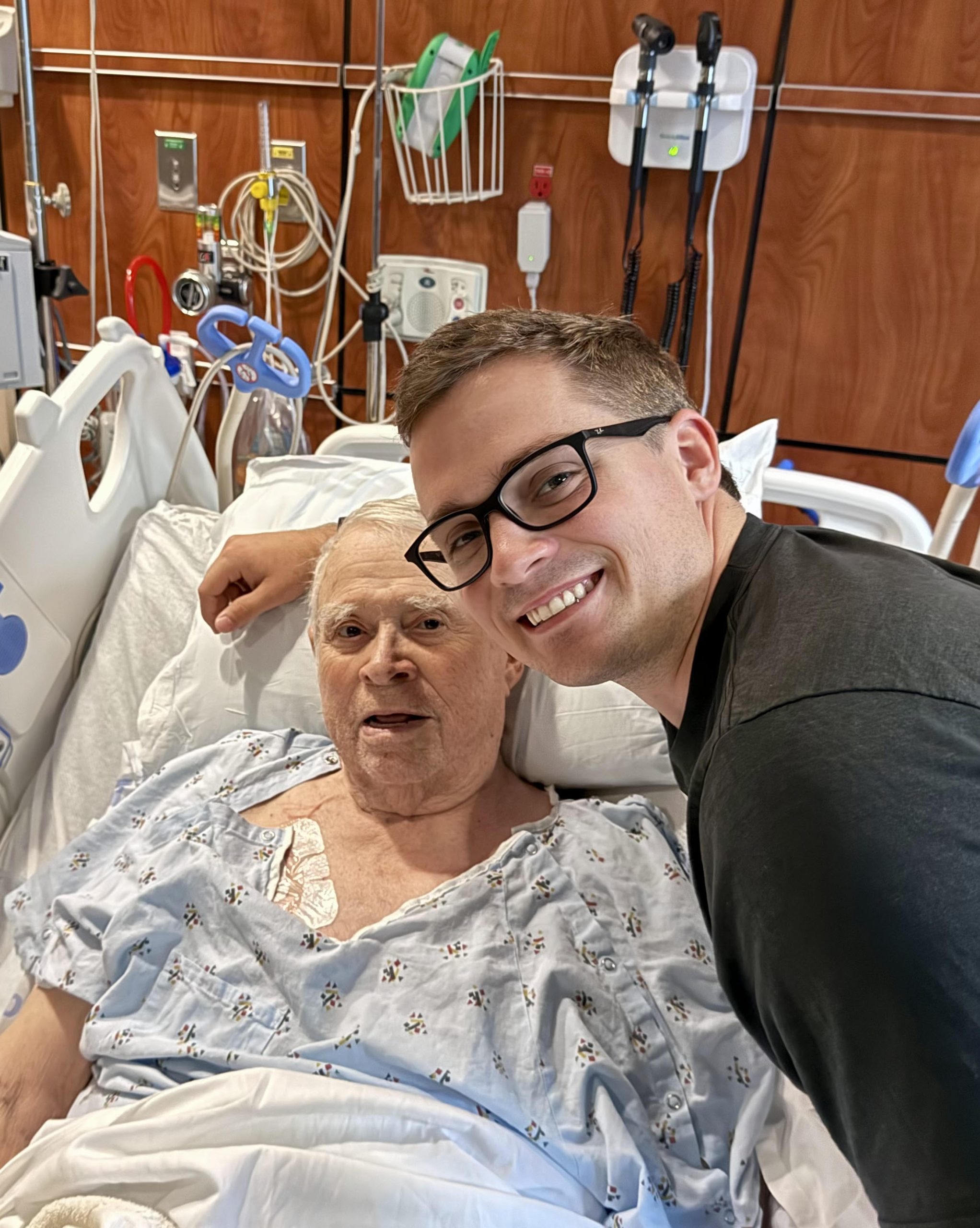
This is my grandfather. Trying to work out which studies he could actually get into is why this site exists.
We are not a clinic.
The studies are run by independent clinics around Charlotte.
You never pay us anything.
Not now, not later.
How we make money
We don’t. Tether is a nonprofit, and no clinic pays us for sending you their way.
Your information
Your health information is held securely and never sold. Not to anyone, ever.
Tether Research Group is an independent directory of clinical trials around Charlotte. We are not a healthcare provider and we do not give medical advice.